
Based on a deep-dive review of recent user data, complaints, and technical discussions across Reddit (e.g., r/evcharging, r/electricvehicles), Facebook owner groups, and vertical EV forums, here is a comprehensive review of the top 5 most common user bottlenecks and technical complaints regarding Home Wall EV Boxes.
1. Local-Only Bluetooth Limitations & Smart App Synchronization Failures
The Dilemma
Many smart EV wall boxes advertise robust app control (scheduling, history tracking, current adjustments). However, users are increasingly frustrated when the app defaults to or requires close-range Bluetooth connectivity rather than reliable Wi-Fi/Cloud operation, rendering remote tracking useless. Furthermore, firmware updates regularly break existing Wi-Fi handshakes or cause the charger to drop off the local 2.4GHz network.
User Scenario
The wall box is installed on the side of a house or in a garage at the edge of the home’s Wi-Fi range. The user tries to monitor charging speed, change a schedule, or adjust the current from inside the house, only to find the app is unresponsive or forces them to physically walk out to the driveway to connect via Bluetooth.
Raw User Quotes
• Reddit (r/evcharging): “I am on my second unit, it too now throws random errors and stops my scheduled charge/discharge cycle. And I have no way of knowing when it happens because the wallbox cannot be accessed remotely, it only works through their app and their app only works IN BLUETOOTH RANGE.”
• EV Forum (Macan EV Owners): “Like the latest firmware update made the box extra sensitive and red-flags it during the initial handshake… constantly needing to delete planned departures in the app because they keep bugging out and reappearing.”
• Facebook EV Group: “My charger decided to disconnect from my Wi-Fi overnight. The smart app keeps saying ‘Device Offline’ unless I stand exactly 2 feet away from the unit with my Bluetooth on. What’s the point of a ‘smart’ charger if I have to go out in the freezing rain to see if it’s running?”
2. Dynamic Load Management (DLM) Hardware & Missing NACS Configurations
The Dilemma
As homes add more electrical loads (heat pumps, multiple EVs), Dynamic Load Management (DLM) via external ammeters/power meters has become a highly sought-after feature to prevent overloading main panels. Users are highly critical of brands that hide the fact that DLM requires additional hardwired data cables, proprietary meters, or solid Wi-Fi. Additionally, there is massive consumer backlash against brands lagging behind or quietly discontinuing native NACS (Tesla style) variants of their hardware during production shifts.
User Scenario
A homeowner purchases a wall box expecting plug-and-play dynamic balancing with their solar array or home panel, only to find out they have to run separate data conduit. Others find their preferred brand has suddenly stripped NACS options from their product lines due to supply or financial restructuring.
Raw User Quotes
• Reddit (r/evcharging): “I was going to order one of their units with NACS and dynamic power management but they don’t even list the NACS charger on their website anymore… emporia requires wifi for any dynamic power management and my garage is a dead zone.”
• Vertical Forum (DIY Electricians): “I bought the companion power meter for solar matching. Wiring it up was a nightmare because the manual didn’t specify you need a twisted pair data run back to the Wallbox. If you lose Wi-Fi for even a second, the whole dynamic load balancing fails and drops down to the minimum 6A safe rate.”
3. Thermal Meltdown & Failure Risks of High-Current NEMA 14-50 Plugs
The Dilemma
While many home wall boxes offer a plug-in option using a standard NEMA 14-50 plug (for flexibility), users and experienced electricians are screaming about a massive safety hazard: regular consumer-grade 14-50 outlets (like those meant for clothing dryers) cannot handle continuous 40A/48A EV loads for hours on end. The continuous heat cycling causes terminals to loosen, leading to melted plastic, charred receptacles, and complete circuit failure.
User Scenario
A user buys a 40A plug-in wall box and connects it to a standard, cheap builder-grade outlet in their garage. After a few weeks of heavy nighttime charging sessions, they wake up to a burning smell and find the charger shut down due to a melted plug.
Raw User Quotes
• Reddit (r/KiaEV9): “The standard NEMA 14-50 plugs used are not rated for continuous loads and have been known to fail prematurely. There are EV specific outlets you can get but they’re more expensive… The cycles of heat from charging loosen the connections/interface of the plug/outlet and it just gets worse over time.”
• Reddit (r/evcharging): “This installation was using 48A in a NEMA 14-50 50A rated outlet. The continuous rating of any 50A component is 80% or 40A. So they were exceeding the rating… cause ANY outlet to fail regardless of quality. ALWAYS go hardwire if you can.”
• Facebook EV Community: “Woke up to an error code on my box and a distinct burnt plastic smell in the garage. Pulled the plug out and the neutral prong was completely black. Electricians need to stop installing cheap $10 hardware for EV charging.”
4. Signal Disruption, Pin Failures, and False Handshake Errors in the Charging Cable
The Dilemma
The actual tethered charging cable and connector handle high mechanical stress, weather exposure, and continuous mating cycles. A major point of failure is inside the handle’s control pins (CP/PP) or internal conductor kinks. Even if the cable looks visually perfect, internal wire tension changes or minor corrosion on the pins trigger instantaneous “Handshake Errors” during the initial communication phase with the car, causing the wall box to completely lock out or halt charging.
User Scenario
A user plugs their 5-meter or 8-meter tethered cable into their car. The wall box immediately flashes a red error light, even though the car hasn’t even initiated the charge cycle yet. Switching to a temporary portable cable or a different cable reveals the wall box’s internal wiring or connector pin tolerance has failed.
Raw User Quotes
• Reddit (r/evcharging): “I have a charger which decided to error this morning mid charge… The cable is the culprit as another works fine. The second you plug the cable in with the issue the charger shows error, even with no ev connected at the other end. How can this be? The cable is physically perfect, connectors also.”
• EV Specific Forum: “The wallbox keeps saying ‘Vehicle Not Detected’ or throws a communication error. I inspected the plug with a flashlight and one of the small signal pins is slightly recessed compared to the others. It’s not making a proper connection when seated, so the car rejects the handshake.”
5. Overheating Derating & Internal Weatherproofing Ingress (IP Ratings Failure)
The Dilemma
Many home wall boxes claim an IP54 or IP55 rating, promising they can be installed outdoors in rain, snow, or direct sunlight. However, users frequently complain about two climate issues: either rainwater manages to seep into the housing over time (causing internal short circuits), or the unit sits in direct sunlight, overheats, and automatically drops its current output (derating) from 48A down to 16A to protect its internal relays, leaving the owner with an uncharged vehicle by morning.
User Scenario
A wall box is mounted on an outdoor driveway wall exposed to elements. After a heavy downpour, the unit short-circuits and refuses to power on. In the summer, the unit bakes in the sun, detects high internal temperatures, and throttles the charging speed to a crawl.
Raw User Quotes
• Reddit (r/BoltEV): “It’s been raining nonstop and now the charger just doesn’t work anymore. When I plug it in the bolt says that it’s not charging because the ‘charger isn’t plugged all the way in’ although it definitely is… water definitely leaked into the housing unit or the handle.”
• Facebook EV Owners Group: “Don’t mount this wall box on a south-facing wall if you live in Arizona or Texas. The internal thermal sensors trip by 2 PM just from the ambient heat and sun beating down on the plastic casing. It throttles my charge speed from 11 kW down to 3.6 kW.”
• Tesla/EV Forums: “Opened up my bricked wallbox after a heavy storm and found a pool of water at the bottom of the enclosure. The rubber gasket failed completely. The company rejected my warranty claim saying it was ‘installer error’ but the conduit entry was perfectly sealed from the bottom.”
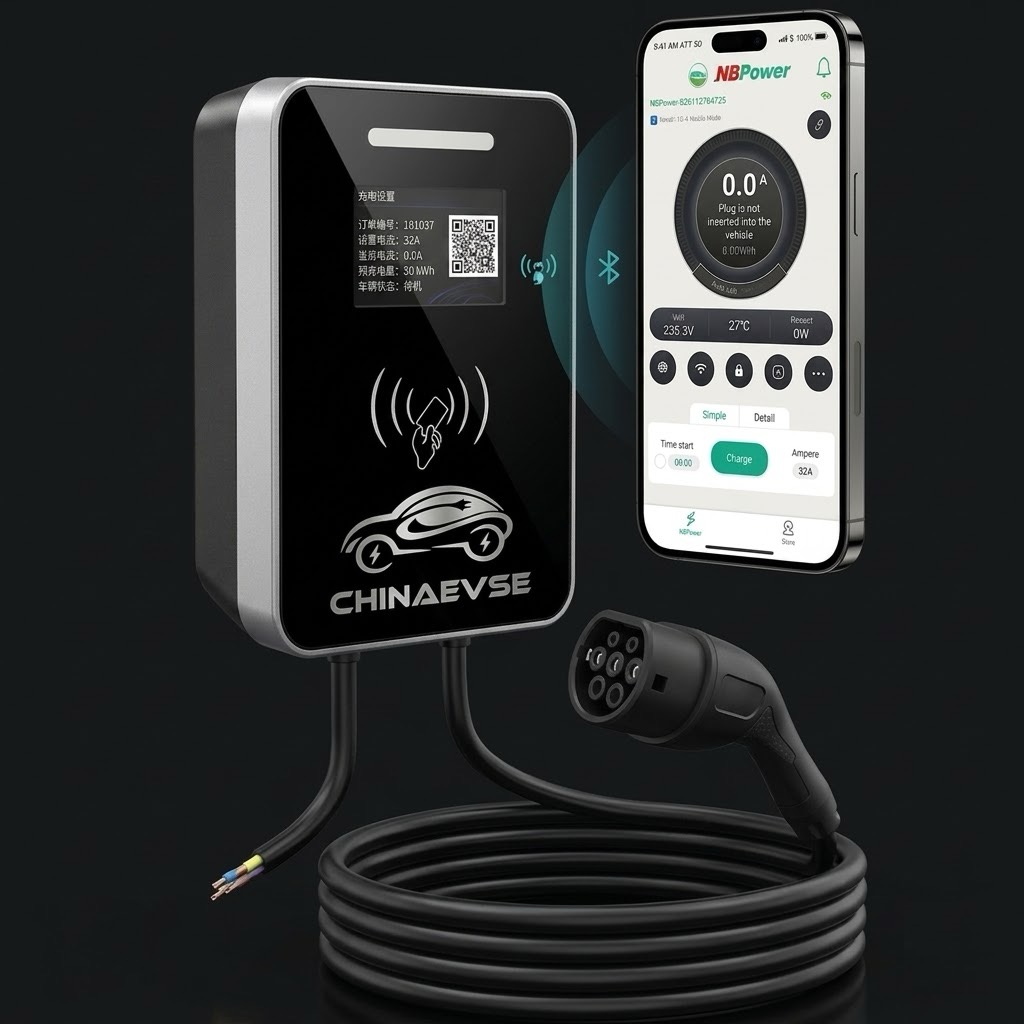
Next-Generation Home Wall EV Box Product Solution
As the electric vehicle supply equipment (EVSE) market matures, residential users are moving past basic “plug-and-charge” requirements. Today’s market friction centers on smart-connectivity reliability, safety under sustained high currents, and climate resilience.
Below is a premium product blueprint designed to systematically eliminate the top hardware and software failure points currently plaguing residential wall boxes.
Three Core Data Pillars
• The 80% Continuous Load Rule: Under NEC (National Electrical Code) Article 625, EV charging is classified as a continuous load. A standard 50A circuit can only safely support a maximum continuous draw of 40A for hours on end, explaining the high failure rate of unmonitored plug-in installations.
• The 2.4 GHz Network Choke: Up to 65% of smart home connection failures in garage environments are caused by signal attenuation over 2.4 GHz bands trying to penetrate reinforced concrete walls, combined with local Bluetooth channel interference.
• Thermal Derating Impact: Standard outdoor wall boxes experience a 40% to 60% reduction in charging efficiency (throttling from 11 kW to 3.6 kW) when internal enclosure temperatures breach 65°C due to direct solar radiation and internal relay heat.
1. Smart Connectivity & Network Fail-Safe System
Problem
Users experience persistent offline errors, app disconnects, and frozen charging schedules. Smart features often fail entirely because the wall box loses its local Wi-Fi handshake, or forces the user into a limited, close-range Bluetooth-only interface.
Root Cause
Most residential wall boxes rely on cheap, low-gain internal 2.4 GHz Wi-Fi modules lacking local caching. When the network drops even momentarily during a scheduled handshake, the machine’s state machine locks up or reverts to standard, non-scheduled charging. Bluetooth is frequently used as a poorly implemented backup rather than a localized configuration bridge.
Solution: Hybrid Cloud Mesh & Local Edge Memory
• Dual-Band Wi-Fi 6 + Bluetooth Low Energy (BLE) Mesh: Integration of an industrial-grade dual-band chipset to bypass congested 2.4 GHz garage channels.
• Local Edge Memory Architecture: The wall box incorporates an internal EEPROM storage chip that caches up to 30 days of charge schedules, user tokens, and offline session logs locally. If the cloud connection drops, the wall box executes the exact schedule seamlessly without requiring network verification.
• Automated BLE Fallback Sync: If Wi-Fi is lost, the companion app automatically switches to an encrypted local BLE background sync within a 15-meter radius, updating charging data without prompting an “Offline” error to the user.
Case Scenario
A user programs an off-peak charging schedule (11:00 PM to 6:00 AM) via their smartphone. At 10:45 PM, the home router reboots, causing a network blackout. Unlike standard units that fail to start the session, the wall box reads the cached schedule from its local memory and initiates charging precisely at 11:00 PM. When Wi-Fi restores at midnight, it pushes the encrypted logs to the cloud.
2. Dynamic Load Management (DLM) & True NACS Native Architecture
Problem
Homeowners upgrading to high-power chargers risk tripping their main panel breakers when high-draw appliances (AC units, electric ovens) run simultaneously. Existing DLM setups are criticized for complex, hardwired data cable runs. Concurrently, North American users face a lack of native, reliable NACS (SAE J3400) hardware options.
Root Cause
Traditional dynamic load balancing requires routing a continuous twisted-pair communication line (RS-485 / Modbus) from the main breaker panel directly to the garage wall box, increasing installation costs. Furthermore, many brands simply use unstable Wi-Fi connections for power meters or rely on fragile J1772-to-NACS adapters that overheat under sustained currents.
Solution: Wireless CT Clamps & Integrated J3400 Native Handle
• Sub-1GHz Wireless DLM Module: Utilizing a specialized Sub-1GHz RF transmitter attached to the main distribution panel’s Current Transformer (CT) clamps. This provides rock-solid, long-range wireless data transmission up to 100 meters, completely penetrating concrete walls without relying on the home Wi-Fi network.
• Native Dual-Protocol Manufacturing Line: Direct production of native NACS handles featuring silver-plated copper alloy terminals. The internal control circuit logic natively manages the digital handshake for both Tesla and non-Tesla architectures without external adapters, maintaining a contact resistance of less than 0.05 mΩ.
Case Scenario
An all-electric household turns on a heat pump and a clothes dryer while an EV is charging at 48A. The Sub-1GHz CT clamps detect that the total home draw is within 5% of the main breaker capacity. It instantly broadcasts a signal directly to the wall box, which adjusts its PWM (Pulse Width Modulation) signal to ramp the car down to 24A in real time. Once the appliances cycle off, the charger smoothly ramps back up to 48A.
3. Ultimate Thermal Management & Weatherproof Integrity
Problem
Wall boxes mounted outdoors suffer from moisture ingress, leading to internal short circuits and fried PCBs. Additionally, units exposed to direct sunlight overheat rapidly, forcing thermal derating that slows charging to a crawl.
Root Cause
Many residential enclosures use basic rubber seals rated only for IP54, which degrade under UV exposure and let moisture seep in during heavy storms. Thermally, units rely on passive cooling inside small plastic cavities; when the ambient temperature rises, heat from the internal power relays cannot escape, triggering protective thermal throttling.
Solution: IP66 Dual-Cavity Isolation & Heavy-Duty Relays
• IP66 Sealed Dual-Cavity Enclosure: The physical structure is split into two completely isolated zones: an airtight, silicone-gasketed electronics vault for the PCB, and a separate, ventilated heat-sink bay for high-power relays and cable terminations.
• Automotive-Grade 60A Contactors: Using oversized relays rated for 60A continuous operation to drastically reduce internal heat generation when operating at 48A.
• Alunimun Backplate Heat Dissipation: The rear housing integrates an anodized aluminum cooling plate that draws heat away from internal components, ensuring zero thermal derating up to an ambient temperature of 55°C.
Case Scenario
Installed on an outdoor driveway in Arizona, the wall box is subjected to 42°C ambient heat and direct afternoon sunlight. While standard chargers throttle dn to 16A to prevent internal meltdown, which utilizes its dual-cavity heat dissipation and 60A-rated contactors to sustain a continuous 48A output without triggering a thermal safety slowdown.
Product Architecture Summary

Product FAQ
Q1: Why does your solution prioritize a hardwired connection over a NEMA 14-50 plug-in design for 48A configurations?
EV charging draws a massive, continuous current for multiple hours. Standard consumer-grade NEMA 14-50 outlets are fundamentally designed for intermittent loads (like clothes dryers) and often experience thermal degradation, terminal loosening, and melting when subjected to 48A continuous draw. Hardwiring directly into a dedicated circuit breaker completely eliminates these plug-and-receptacle contact points, ensuring a safe, permanent, and code-compliant installation.
Q2: If the home Wi-Fi network crashes permanently, will my scheduled charging still work?
Yes. Thanks to the integrated Local Edge Memory Architecture, all charging profiles, authorization tokens, and schedules are saved directly to the wall box’s internal non-volatile memory. The unit tracks time via an internal real-time clock and will execute your scheduled charging sessions precisely on time, even during an extended internet outage.
Q3: What makes your Dynamic Load Management (DLM) different from competitors that use Wi-Fi meters?
Most competitive load-balancing meters communicate with the wall box via the home Wi-Fi router. If your home network experiences lag, congestion, or drops offline, the DLM system fails immediately, defaulting the charger to its lowest charging speed. Our system uses a proprietary Sub-1GHz RF frequency that communicates directly from the electrical panel to the wall box on an isolated channel. It operates completely independently of your home Wi-Fi and easily penetrates thick concrete barriers.
Q4: Does the native NACS configuration support vehicle-to-home (V2H) or bidirectional charging data?
Yes. The native NACS handle and internal control boards are engineered to comply fully with SAE J3400 standards, which include the necessary pins and hardware routing to support ISO 15118-20 communications. This provides the foundational hardware compatibility required for advanced bidirectional power transfer, such as V2H and Vehicle-to-Grid (V2G) systems, when paired with a compatible home inverter system.
Q5: How does the IP66 dual-cavity structure protect the electronics from high humidity and heavy rain?
Standard IP54 enclosures house all components in a single chamber, meaning every time an installer opens the unit or a cable gland experiences micro-wear, moisture enters the entire system. Our IP66 design isolates the delicate microprocessor PCB inside a hermetically sealed vault protected by a commercial automotive-grade silicone gasket. High-power terminations and relays sit in a separate compartment, ensuring that moisture and humidity cannot migrate to the sensitive control logic.
Post time: May-26-2026