
Core Difference at a Glance
-
400A CCS2 to GB/T Adapter: Plugs into a CCS2 Charging Station to charge a GB/T EV (Chinese standard vehicle).
-
400A GB/T to CCS2 Adapter: Plugs into a GB/T Charging Station to charge a CCS2 EV (European/International standard vehicle).
Technical Comparison
| Specification / Feature | 400A CCS2 to GB/T Adapter | 400A GB/T to CCS2 Adapter |
| Input (Station Side) | CCS Combo 2 Female Receiver | GB/T DC Female Receiver |
| Output (Vehicle Side) | GB/T DC Male Plug | CCS Combo 2 Male Plug |
| Target Vehicle | Chinese EVs (BYD, NIO, Xpeng, Zeekr, Geely, etc.) | European & International EVs (Porsche, BMW, Audi, Mercedes, Tesla EU) |
| Target Infrastructure | CCS2 DC fast-charging networks (Europe, Middle East, SE Asia, South America) | GB/T DC fast-charging networks (Mainland China, select regional infrastructure) |
| Protocol Conversion | PLC (DIN 70121 / ISO 15118) to CAN Bus (GB/T 27930) | CAN Bus (GB/T 27930) to PLC (DIN 70121 / ISO 15118) |
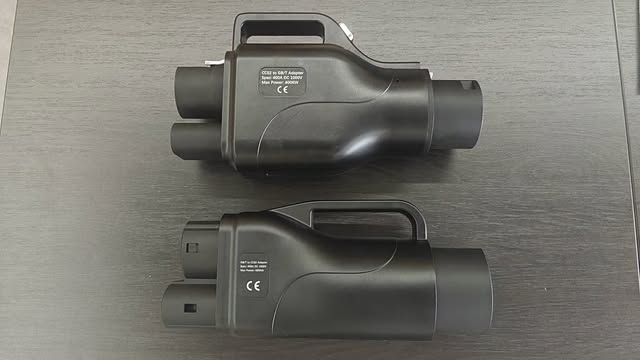
Key Technical Details
1. Active Protocol Handshake (PLC vs. CAN)
Neither adapter is a passive wiring converter. Because CCS2 and GB/T use fundamentally different signaling layers, both adapters contain internal control chips:
-
CCS2 Protocol: Uses HomePlug Green PHY Power Line Communication (PLC) over the Control Pilot (CP) pin.
-
GB/T Protocol: Uses Controller Area Network (CAN bus) communication over dedicated CAN-H/CAN-L pins, along with low-voltage auxiliary supply pins (A+ / A-).
The adapter’s internal MCU acts as a real-time protocol translator, mapping state requests, voltage/current limits, and battery status between the station and the car’s BMS.
2. High-Power Considerations at 400A
At a 400A continuous rating (delivering upwards of 250–320 kW depending on system voltage), both adapter types require:
-
Thermal Management: Dual NTC/PT100 temperature sensors on the main DC+ and DC- copper contacts to signal a derating or emergency shutdown if temperatures exceed ~85°C.
-
Auxiliary Power: An internal battery or station-supplied power circuit to keep the translation microcontroller active during the charge handshake.
-
Electronic Locking: Locking pins on both the station side and vehicle side to prevent disconnection under load.
Post time: Jul-31-2026